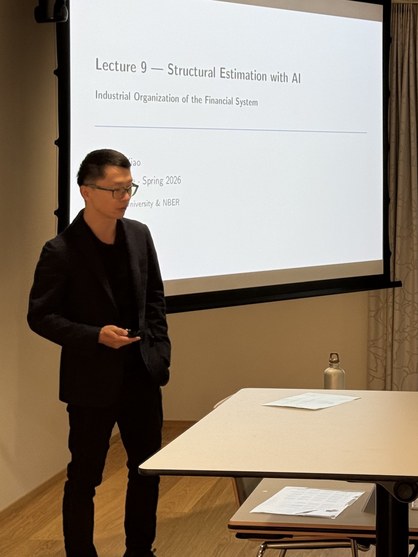
This advanced economics course targeted PhD students, academic faculty members, and research economists in policy institutions. It covered the basic building blocks of heterogeneous agent models and explored selected applications of these models.
#GerzenseeInsights “An Introduction to Macroeconomics with Household Heterogeneity”
3 min read

-
Households react too much to changes in expected permanent income.
Household income over the life cycle typically follows a hump-shaped pattern: rising during early working years, peaking in middle age (around the 50s), and declining as individuals approach retirement. The Permanent Income Hypothesis (PIH) (e.g., Friedman, 1957; Hall, 1978) predicts that households should smooth consumption over their lifetime—borrowing when young, saving during peak earning years, and dissaving in retirement. However, household consumption also exhibits a hump-shaped pattern, closely mirroring income. This discrepancy, known as the "excess sensitivity puzzle," suggests that households respond more to predictable income changes than the PIH envisages. This puzzle can be partly explained through the lens of heterogeneous agent models, which account for factors such as liquidity constraints faced by younger households (Zeldes, 1989; Deaton, 1991) and precautionary saving motives (Gourinchas and Parker, 2002).
-
Wealth inequality matters for the cost of recessions.
In classical representative agent models, the costs of recessions and business cycles are often considered small. For instance, Lucas (1987) estimated that households would be willing to give up less than 1% of their consumption to insure against business cycle fluctuations. The reason is that as household income falls, they can dissave, thus stabilizing consumption. However, Krueger et al. (2016) challenge this view, demonstrating that the costs of business cycle fluctuations can be substantially higher in a richer heterogeneous agent framework. Surprisingly, low-wealth households, despite holding virtually no assets, can disproportionately drive aggregate consumption due to sharp increases in their savings as the recession hits.
-
The end of the American dream? Educational reforms can have large effects on lifetime consumption.
The U.S. currently experiences low intergenerational earnings and education mobility, coupled with high child poverty. Is this the end of the American dream? Maybe, but two policy proposals give hope: Investments in better primary and secondary education and free access to tertiary education. Krueger et al. (2024) quantify the effects of introducing these two measures, using a rich heterogeneous-agent model. They find that the average lifetime consumption increase for newborns ranges from 11% to 15%. Furthermore, the reforms are self-financing over the long horizon but require access to additional government borrowing. Surprisingly, if forced to choose between either of the two reforms, better schooling yields higher welfare gains, which are also more equitably distributed but take longer to materialize. However, according to Krueger et al. (2024), an optimal approach involves a balanced split between the two policies.
-
A driving force in many heterogeneous agent models is precautionary savings.
A key feature of many heterogeneous agent models is that households receive different income realizations, which, often by assumption, are not perfectly insurable. This induces consumption risk which, because households are assumed to be risk-averse, is undesirable to them. Households can reduce this consumption risk by engaging in precautionary savings—additional savings motivated by the need to self-insure against income risk. However, whether households effectively translate this risk aversion into higher precautionary savings depends on two factors: the shape of their utility function and the presence of borrowing constraints.
References
- Deaton, A. (1991). Saving and Liquidity Constraints. Econometrica, 59(5), 1221-1248.
- Gourinchas, P.-O., & Parker, J. A. (2002). Consumption Over the Life Cycle. Econometrica, 70(1), 47-89.
- Friedman, M. (1957). A Theory of the Consumption Function. Princeton University Press.
- Hall, R. E. (1978). Stochastic Implications of the Life Cycle-Permanent Income Hypothesis: Theory and Evidence. Journal of Political Economy, 86(6), 971-987.
- Krueger, D., Ludwig, A., & Popova, I. (2024). Shaping Inequality and Intergenerational Persistence of Poverty: Free College or Better Schools. Working Paper.
- Krueger, D., Mitman, K., & Perri, F. (2016). Macroeconomics and Household Heterogeneity. Working Paper.
- Lucas, R.E. (1987). Models of Business Cycles. Wiley-Blackwell.
- Zeldes, S. P. (1989). Consumption and Liquidity Constraints: An Empirical Investigation. The Journal of Political Economy, 97(2), 305-346.
This summary was compiled by Remo Taudien. Remo is an academic assistant at the Study Center Gerzensee and a PhD student at the University of Bern.