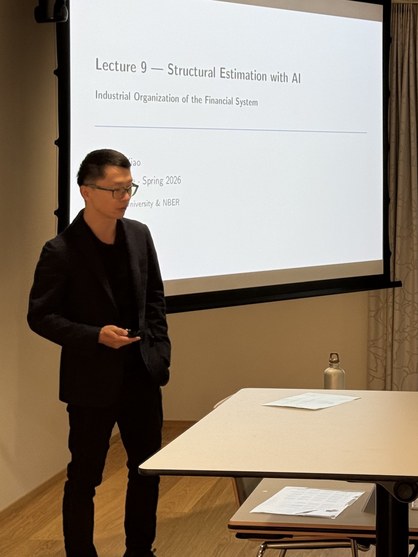
This advanced economics course was targeted to PhD students, academic faculty members, and research economists in policy institutions. It covered advanced tools in mechanism design, focusing on topics such as privacy-preserving signals, non-discriminatory individual pricing, and learning with mis-specified models, among many others.
#GerzenseeInsights "New Problems in Institution Design"
3 min read

-
Statistical discrimination may occur across groups with identical skills
Two groups can earn different average wages even if they have the same average productivity, when the signals about their productivity differ in precision. Phelps (1972) and Aigner and Cain (1977) showed that when wages depend only on expected productivity given a signal, differences in signal precision across groups lead to systematically different outcomes. For example, suppose two equally productive groups, A and B, are evaluated by a person who knows group A better (e.g., group A consists of economists and the evaluator is an economist as well), thereby obtaining more precise signals while otherwise unbiased. The evaluator, aware of the noise, places less weight on extreme scores for group B and more weight on their overall average. As a result, high-ability individuals in group B are undervalued, while low-ability individuals are overvalued, shifting the group’s average wage. The inequality in outcomes arises purely from differences in information quality, not from actual productivity differences.
-
Preserving privacy using informative signals is possible
Sometimes we want to learn about someone’s skill without simultaneously revealing protected characteristics such as race or gender. The difficulty is that many observable signals — test scores, work samples, even speech patterns — are statistically correlated with these characteristics, allowing unintended inferences about those protected characteristics. Privacy-preserving signals are designed to be informative about the target variable (skill) while limiting what can be inferred about sensitive attributes. A powerful approach is to rely on quantiles: for instance, suppose college applicants reveal only the quantile of their test score within their protected group (e.g., Black females). Because quantiles are uniformly distributed across groups, this conveys information about the applicant’s skill while revealing nothing about their group membership. Strack and Yang (2024) prove that a signal is privacy-preserving if and only if it is a garbling (a transformation with less information) of a reordered quantile signal.
-
Learning from misspecied models is still useful
Interpreting data always requires a model. But what if the model is misspecified — not even allowing the possibility of the true state? Berk’s theorem (1966) shows that in such cases, the maximum-likelihood estimator still converges to the pseudo-true parameter: the point in the model class that minimizes the Kullback–Leibler divergence from the truth. In other words, estimation delivers the “closest” approximation to reality within the chosen family, in terms of information loss. This is encouraging: since all models are, to some degree, wrong, the theorem reassures us that learning from data can nevertheless improve forecasts.
-
But learning can be self-defeating when using a misspecifed model
Even though learning can improve forecasting even with misspecified models, it does not follow that learning always leads to better outcomes. For example, Heidhues et al. (2018) show that overconfidence can lead to self-defeating learning. When team members work together, they observe results and update their beliefs about each other’s abilities. If one member is overconfident in her ability (hence using a misspecified model), she will attribute poor team performance to her teammate having low skills. In turn, she will allocate more and more tasks to herself. This self-reinforcing dynamic produces increasingly disappointing outcomes, further entrenching the misdirected learning. The initial overconfidence thus leads to a misallocation of tasks: one team member ends up doing the bulk of the work, even though collaboration would have been more efficient. This illustrates that, under misspecified models, more learning can be self-defeating and lead to worse outcomes.
Selected References:
- Aigner, D. J., & Cain, G. G. (1977). Statistical Theories of Discrimination in Labor Markets. Industrial and Labor Relations Review, 30(2), 175–187
- Berk, R. H. (1966). Limiting Behavior of Posterior Distributions when the Model is Incorrect. Annals of Mathematical Statistics, 37(1), 51–58
- Heidhues, P., Köszegi, B., & Strack, P. (2018). Unrealistic Expectations and Misguided Learning. Econometrica, 86(4), 1159–1214
- Phelps, E. S. (1972). The Statistical Theory of Racism and Sexism. American Economic Review, 62(4), 659–661
- Strack, P., & Yang, K. H. (2024). Privacy Preserving Signals. Econometrica, 92(6), 1907–1938
This summary was compiled by Remo Taudien. Remo is an academic assistant at the Study Center Gerzensee and a PhD student at the University of Bern.