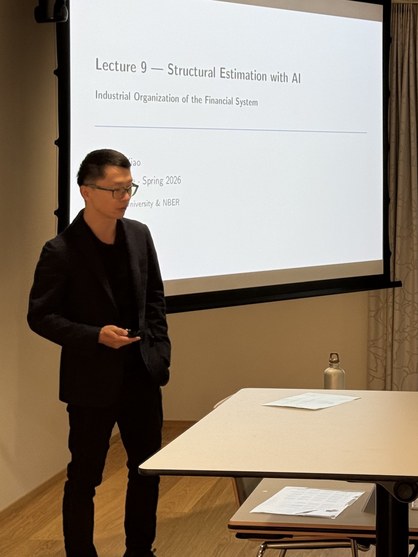
This advanced economics course targeted PhD students, academic faculty members, and research economists in policy institutions.
#GerzenseeInsights “Recent Advances in Economic Growth"
3 min read

-
Slower knowledge diffusion can explain why productivity growth has stagnated despite a rise in inventors.
In the U.S., the number of inventors has grown over the past 20 years, while productivity growth has declined. Akcigit and Ates (2023) build a model featuring endogenous innovation, firm competition, and knowledge diffusion to explore this disconnect. Among several factors – ranging from lower corporate taxes, changes in entry costs, and lower worker bargaining power – they find that only reduced knowledge diffusion can jointly explain various empirical patterns. Indeed, evidence points to market leaders increasingly relying on intellectual property protections to block knowledge spillovers.
-
Inventors employed by large incumbent firms are not as inventive as their peers hired by smaller entrant firms.
U.S. data shows that a growing share of inventors are employed by large incumbent firms, partly because they pay a higher salary – a so-called “incumbent premium.” Unfortunately, these inventors are less productive (as measured by both the quantity and quality of inventions) than the ones hired by smaller firms. For example, inventors produce 8% fewer patents 4 years after being hired by a large incumbent than a comparable inventor hired by a small entrant. However, a large fraction of R&D subsidies go precisely to firms with more than 1000 employees. This suggests that public R&D funds are misallocated and young firms in which inventors can be particularly productive are at a disadvantage when it comes to public R&D funding and promising startups grow significantly slower when their inventors are poached by large incumbent firms (Akcigit and Ates, 2023 and Akcigit and Goldschlag, 2023).
-
Industrial policy directed at incumbent firms negatively impacts innovation and productivity growth.
In addition to looking at relationships in the data (see previous bullet), the question of which firms should be targeted with industrial policy can also be studied in general equilibrium models. This not only allows researchers to understand the role of firm-level heterogeneity but also to conduct counterfactual exercises to analyze the effects that hypothetical policies would have on productivity and welfare. Using such a model, calibrated to match various features of the US economy, one can show that a very effective policy is to tax operation costs of incumbent firms rather than providing subsidies. The main reason for the desirability of such taxes is that they encourage the exit of inefficient incumbents, which releases skilled labor for other incumbents and new entrants. Once again, these results suggest that the current system, where large incumbents are the primary beneficiaries of R&D subsidies, may not necessarily be the most efficient use of public resources.
-
Education is essential for training R&D workers and preparing transformative entrepreneurs.
Using Danish administrative data, Akcigit et al. (2025a) identify the factors that influence the decision to become either an entrepreneur or an inventor. While entrepreneurship is largely driven by IQ and parental entrepreneurial activity, the likelihood of becoming an R&D worker is strongly associated with IQ and educational background. Moreover, “transformative entrepreneurs” – those who create businesses to innovate and grow – tend to have higher IQs than “subsistence entrepreneurs.” The authors develop a model of firm dynamics and occupational choice that reflects these patterns. The model underscores the crucial role of education in fostering innovation and productivity. Education is not only essential for training R&D workers but also for preparing transformative entrepreneurs, who ultimately employ those workers. Alleviating financial constraints that limit access to higher education enables this synergy between entrepreneurs and inventors. According to the model, such a policy is the most effective means of spurring economic growth, particularly when public budgets are tight. A symbiotic relationship between entrepreneurs and inventors is crucial for a vibrant, dynamic, and progressive society.
-
Politically connected firms hinder business dynamism and innovation.
Using micro-level data on Italian firms and politicians, Akcigit et al. (2023) study the impact of having local politicians being simultaneously employed in private companies on productivity dynamics. Several key findings emerge. First, more politically connected industries exhibit lower rates of firm entry. Second, industries with more political connections grow more slowly and are less productive. Finally, firms with more politically connected employees exhibit a higher probability of survival. These results suggest that political connections can distort market mechanisms by allowing less productive firms to survive and making it harder for new firms to enter the market.
Selected References:
-
Akcigit, Ufuk, and Sina T. Ates. "What happened to US business dynamism?." Journal of Political Economy 131.8 (2023): 2059-2124.
-
Akcigit, Ufuk, and Nathan Goldschlag. Where have all the" creative talents" gone? Employment dynamics of us inventors. No. w31085. National Bureau of Economic Research, 2023.
-
Akcigit, Ufuk, Salomé Baslandze, and Francesca Lotti. "Connecting to power: political connections, innovation, and firm dynamics." Econometrica 91.2 (2023): 529-564.
-
Akcigit, Ufuk, Harun Alp, Jeremy Pearce, and Marta Prato. “Transformative and Subsistence Entrepreneurs: Origins and Impacts on Economic Growth”. No w33766. National Bureau of Economic Research, 2025
This summary was compiled by Michael Barczay. Michael is a research associate and teaching assistant at the Study Center Gerzensee and PhD candidate in Economics at the European University Institute (EUI) in Florence, Italy.